
Community · Associations · Industry
A Community Guide toResponsible Data Center Development
Data centers provide the physical infrastructure behind cloud services, AI, communications, healthcare, commerce, and public services. As your Ally, we connect communities, local governments, and industry with trusted resources and plain-language tools so responsible projects can earn support, address local priorities, and deliver lasting value.

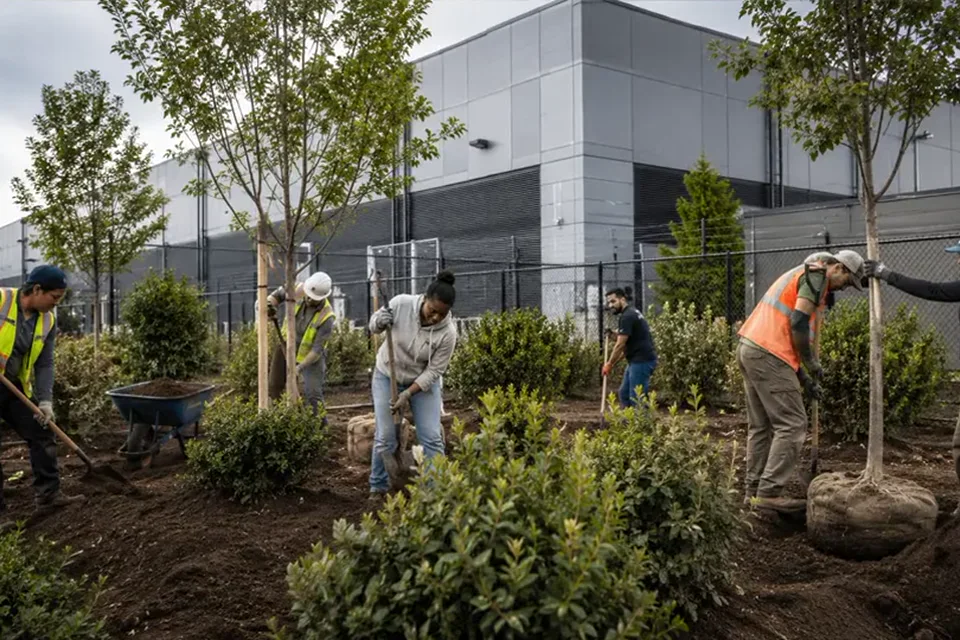
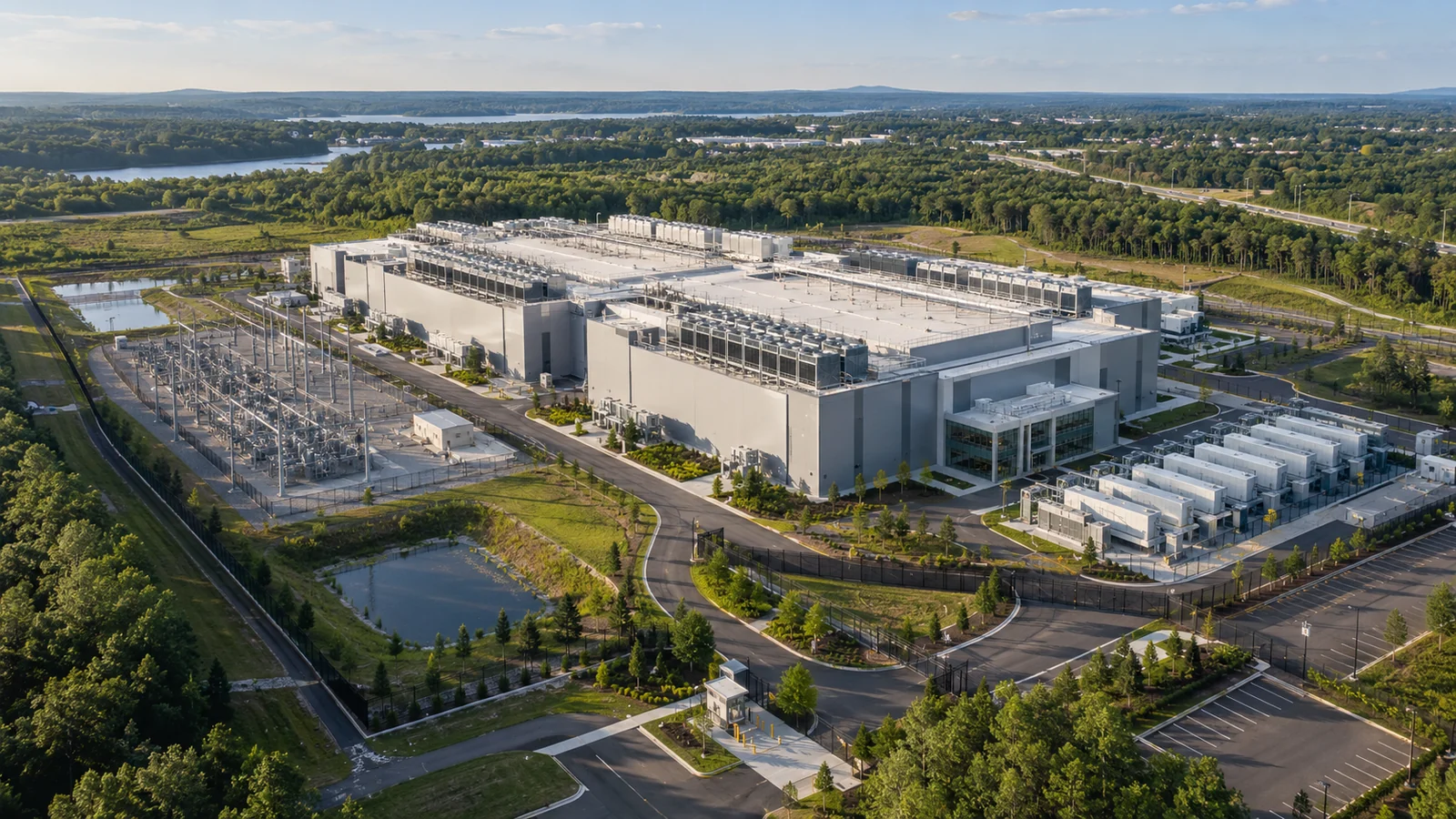
01 / KEY POINTS
One building. Five community questions.
Responsible projects can deliver essential infrastructure and lasting local value. Design, climate, operating conditions, and local agreements determine how well they do it.
02 / COMPARISON LAB
Test responsible choices.
See what changes.
These calculators show how siting, power, cooling, sound controls, and community commitments can improve projected outcomes. Replace every starting value with locally sourced data before making a public claim.
SITE / COMMUNITY COMPATIBILITY SCREENING RUBRIC
How much separation and landscape restoration are planned?
Distance from homes is a starting point—not a universal safety rule. A credible siting review identifies the closest receptor, terrain, transmission routes, emergency access, and future land use.
Screening-rubric weighting: Distance to the nearest home contributes 70% of the score. The native tree or plant replacement target contributes 30%. This score is not a setback, zoning, health, safety, or regulatory determination.
SCREENING RUBRIC SCORE · NOT A REGULATORY STANDARD
Good screening-rubric starting point
Ask the developer: What is the nearest home today and under the future land-use plan, and where will the mature native canopy be measured?
03 / THE EVIDENCE GUIDE
Strong proposals support their benefits with context.
Use the same six-part label on every public claim. It helps communities recognize credible project benefits and makes source updates easier.
ANATOMY OF A CREDIBLE CLAIM
In Loudoun County, data centers added$16 billion in real-property value in2024, bringing the total to $41 billion, according to Loudoun County’s FY2026 budget materials.
Why this claim works
It is positive without being vague. It names the place, the type of value, the one-year increase, the resulting total, the period, and the government source. It does not turn assessed property value into jobs, cash in hand, or a guarantee of lower taxes.
What to ask next: How much of that assessed value becomes recurring local revenue, how volatile is the equipment tax base, and which services or reserves receive the money?
Review Loudoun County’s published figures ↗STARTER SOURCES / READY TO EXPAND
01Power + national energyU.S. Department of Energy · Lawrence Berkeley National Laboratory+
SOURCE TITLE2024 United States Data Center Energy Usage Report
LINK OR FILEOpen source ↗
WHAT IT SUPPORTSU.S. electricity use, PUE trends, facility types, and 2028 scenarios.
DATE CHECKEDJuly 14, 2026
02Water + coolingLBNL national model · local utility records · project mechanical narrative+
SOURCE TITLELBNL national energy and water model
LINK OR FILEOpen source ↗
WHAT IT SUPPORTSDirect water consumption by facility category and cooling system context.
DATE CHECKEDJuly 14, 2026
03Sound + barriersFHWA guidance · local ordinance · acoustic study · post-construction test+
SOURCE TITLEFHWA: Highway Traffic Noise Barriers at a Glance
LINK OR FILEOpen source ↗
WHAT IT SUPPORTSTypical 5–10 dB barrier reduction and the need for solid, tall, long barriers without openings.
DATE CHECKEDJuly 14, 2026
04Jobs + community benefitsU.S. Census Bureau · county tax records · development agreement+
SOURCE TITLEU.S. Census: Employment in Data Centers
LINK OR FILEOpen source ↗
WHAT IT SUPPORTSNational employment growth and the distinction between direct and supported jobs.
DATE CHECKEDJuly 14, 2026
05DMV regional contextLoudoun County · Maryland county records · District zoning+
SOURCE TITLELoudoun County: Data Centers in Loudoun County
LINK OR FILEOpen source ↗
WHAT IT SUPPORTSLocal planning, tax-base context, public process, and regional source discovery.
DATE CHECKEDJuly 14, 2026
06Native canopy + stormwaterEPA tree guidance · local forestry plan · approved landscape plan+
SOURCE TITLEEPA: Stormwater Trees Technical Memorandum
LINK OR FILEOpen source ↗
WHAT IT SUPPORTSSelecting trees for climate, soil, mature canopy, sunlight, moisture, and long-term maintenance.
DATE CHECKEDJuly 14, 2026
TAKE THIS TO THE MEETING
Six questions that get past the headline.
Each question includes three likely answer types so you can recognize a strong commitment, a partial answer, or a warning sign.
01What is the maximum—not just average—electric demand?
+
A phased MW schedule, maximum demand, expected annual load factor, utility agreement, and who pays for required upgrades.
A single average MW number with no seasonal peak, phase date, or interconnection milestone.
Power is available and the utility will handle it—without a filed study, cost allocation, or maximum demand.
02Which cooling and heat-rejection systems will operate at each phase?
+
Named equipment by phase, closed-loop boundaries, peak-day mode, backup mode, and annual potable and reclaimed-water estimates.
The design is closed-loop—without explaining whether cooling towers or other evaporative heat rejection still consume water.
The technology is proprietary, so no operating mode or water information can be provided.
03Is reported water use withdrawal, consumption, potable water, or all three?
+
Separate average and peak values for withdrawal, consumption, discharge, potable water, and reclaimed water.
One annual water number with no source, peak-day demand, or distinction between withdrawal and consumption.
The system recirculates water, therefore the project uses no water.
04Where will sound be measured, at what times, and in which units?
+
Property-line and residential receptor results in dBA and dBC, octave-band and tonal analysis, nighttime limits, and generator testing.
A modeled daytime dBA result at the property line only, with no low-frequency or emergency-operation case.
The equipment meets manufacturer ratings, so neighborhood measurements are unnecessary.
05Which community benefits are written, funded, and enforceable?
+
Dollar amounts, recipients, delivery dates, local maintenance and vendor targets, workforce programs, and public annual reporting.
A general promise to support schools and local hiring without a budget, owner, or schedule.
Benefits will be decided after approval and reported only at the operator’s discretion.
06Who publishes performance after the building begins operating?
+
A named owner publishes annual power, water, sound, jobs, tax, and outreach results, with a correction process and independent verification.
The operator will share selected sustainability metrics but has no fixed reporting date or local contact.
Operational data will remain confidential and there is no post-construction reporting commitment.
Add these six questions to your project brief.
They will remain attached to My Ally Brief with your saved lab scenario and selected evidence cards.
FREE MEMBERSHIP · THE ALLY UPDATE
Become an Ally.
Receive a concise monthly roundup of meaningful Project Watch changes, public meetings, research, events, and new tools.- Choose the topics and locations that matter to you
- Keep all public information open and accessible
- Unsubscribe at any time