
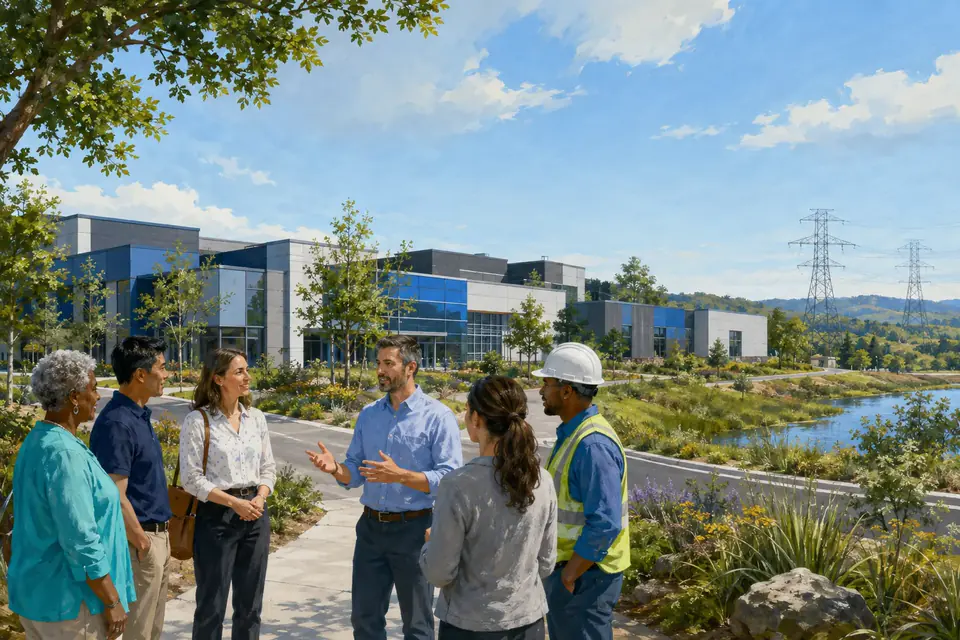
A productive data center conversation does not begin with “good” or “bad.” It begins by defining what is proposed, what will be measured, who is responsible, and what happens if commitments are missed.
1. Is the site compatible with its neighbors?
Identify the nearest existing and planned homes, schools, parks, and other sensitive uses. Then examine setbacks, mature native landscaping, terrain, transmission routes, emergency access, stormwater, and future expansion—not only the first building shown on a rendering.
2. What is the maximum power requirement, and who pays?
A strong answer includes the phased megawatt schedule, maximum demand, expected annual use, utility studies, grid upgrades, cost allocation, backup generation, and the conditions that apply before each phase can connect.
3. How will heat be removed, and what water will be used?
Name the cooling and heat-rejection equipment for every operating mode. Separate potable and reclaimed water, withdrawal and consumption, average and peak-day demand, discharge, maintenance, and emergency conditions.
4. Where and how will sound be measured?
Require property-line and nearest-residential-receptor measurements, daytime and nighttime limits, dBA and dBC where appropriate, tonal and low-frequency analysis, generator testing, complaint response, and post-construction verification.
5. Which benefits are written, funded, and enforceable?
Jobs, tax revenue, school programs, local purchasing, landscape maintenance, workforce investment, and community funds are most credible when the amount, recipient, schedule, responsible party, reporting method, and remedy are documented.
The goal is not a perfect project description. It is a public record that makes the important promises specific enough to verify after construction.
PRIMARY SOURCES
Verify the public record
These official or institutional sources support the guide. Check the original text and its effective date before relying on a summary.